You have probably seen “TDS” on a water purifier box or must have heard it in an advertisement. But what does TDS in water actually means and what TDS values should you look for in the water you drink every day?
This guide covers what TDS is, the ideal TDS level for drinking water, what happens when it is too high or too low, and how to fix it?
Table of Contents
ToggleWhat Is TDS in Water?
TDS stands for Total Dissolved Solids. It is the total amount of dissolved substances in water, measured in milligrams per litre (mg/L) or parts per million (ppm). The two units are effectively the same for drinking water.
These dissolved substances include:
- Minerals: calcium, magnesium, potassium and sodium etc.
- Salts: chlorides, sulphates and bicarbonates etc.
- Trace elements and contaminants: nitrates, fluoride, iron?
- Water picks these up as it passes through rocks, soil and pipes. That is why groundwater, such as borewell water usually has a different TDS from river or reservoir water or supplied by a municipality.
How Is TDS Measured?
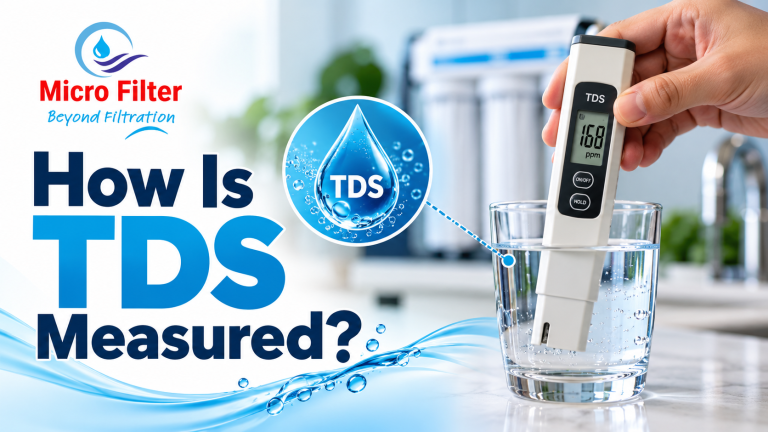
TDS is measured with a digital TDS meter. The meter checks how well the water conducts electricity, because dissolved salts and minerals raise conductivity. It then converts this into a ppm reading.
A TDS meter has one big limitation. It tells you the quantity of dissolved solids, not the type of solids. A reading of 200 ppm could be healthy calcium and magnesium however it could include harmful contaminants. Bacteria, viruses, pesticides and many chemicals are not shown by a TDS reading either. A detailed lab test is the only way to know exactly what is in your water.
Ideal TDS Level for Drinking Water
Below is the widely used TDS scale, based on WHO guidance:
TDS Level (ppm) | Water Quality |
Below 50 | Very low mineral content; may taste flat |
50 – 150 | Ideal for drinking |
150 – 300 | Excellent, good taste and minerals |
300 – 500 | Acceptable, but on the higher side |
500 – 900 | Poor taste; treatment recommended |
900 – 1,200 | Poor; not recommended for regular drinking |
Above 1,200 | Unacceptable |
In short: the ideal TDS level for drinking water is between 50 and 150 ppm and anything up to 300 ppm is considered good.
Is High TDS Water Harmful?
High TDS is not always a direct health hazard by itself, but it is a warning sign. When TDS crosses 500 ppm you may notice:
- Salty, bitter or metallic taste
- Hard water problems: white scale on taps and kettles and dull, dry skin and hair
- Reduced appliance life: scaling damages geysers, boilers, washing machines and industrial equipment
- Possible health concerns: if the high reading comes from nitrates, arsenic, lead or excess fluoride, long-term use can affect kidneys, digestion and overall health
- Cloudy or unpleasant tea, coffee and cooked food
For industries, hospitals, hotels, restaurants and housing societies, high TDS also means higher maintenance costs and inconsistent product quality.
Is Very Low TDS Water Bad?
Yes, it can be. Water with TDS below 30–50 ppm has almost no natural minerals. It can taste flat and drinking it as your only water source over the long term may mean you miss out on calcium and magnesium.
This is a common issue when an RO system is run without a mineral balancing feature. Purer is not always better. Balanced is better.
How to Reduce TDS in Water
The right method depends on how high is your TDS and what is causing it.
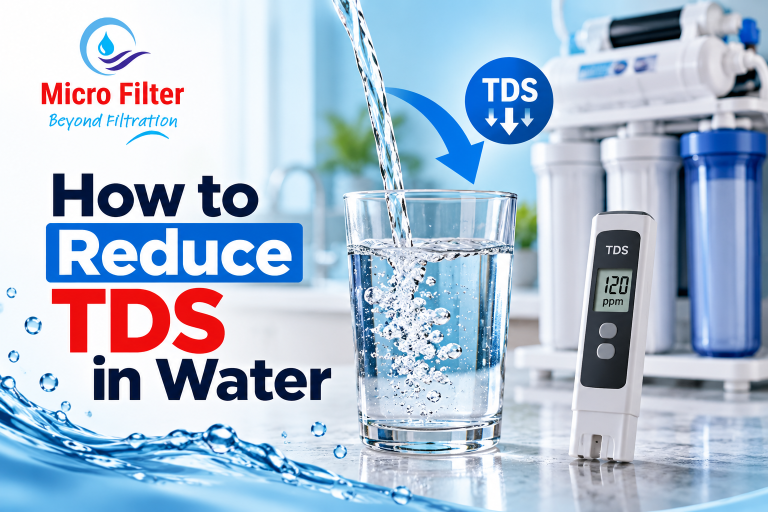
- Reverse Osmosis (RO): The most effective method for reducing dissolved solids. A semi-permeable membrane removes up to 90–95% of TDS, along with many contaminants.
- Distillation: Effective, but slow and energy-intensive. It is mainly used for lab or specialised needs.
- Deionization (DI): Used in industrial and laboratory settings where ultra-pure water is required.
- Water softeners: These reduce hardness (calcium and magnesium) but do not fully reduce total TDS.
Choose the Right Purification Based on Your TDS
- Below 200 ppm: UV or UF purification is usually enough
- 200 – 500 ppm: RO with a TDS controller so essential minerals are retained
- Above 500 ppm: Full RO purification or a customised treatment setup
- Commercial and industrial use: A properly designed treatment plant based on a full water analysis
Not sure which one fits? Get your water tested first. Guessing often means overspending on the wrong system or under-treating water that needs more.
Why Choose Microfilter for Your Water Treatment Needs?
Every water source is different, so a single ready-made solution rarely works. Microfilter helps homes, businesses and industries get the right treatment for their water starting with understanding what is actually in it.
With Microfilter, you get:
- Solutions customised matched to your water quality, not a one-size-fits-all product kind.
- Customised Systems built for the needs of homes, commercial spaces and industries.
- Guidance from a team of experts that understands water treatment, not just sales.
- Support you can rely on for installation and after-sales service as well.
Frequently Asked Questions
1. What is a safe TDS level for drinking water?
2. Is 100 TDS water good for drinking?
3. Is 500 TDS water safe to drink?
4. Does boiling water reduce TDS?
5. Can a TDS meter tell me if my water is completely safe?
Final Thoughts
TDS is a useful first indicator of your water quality, but it is only one part of the story. Aim for 50–150 ppm for drinking, treat water above 500 ppm and never rely on a TDS meter alone to judge safety.
Not Sure About Your Water Quality? Talk to Microfilter Today.
Whether it’s for your home, office, factory or housing society, our team will help you find the right water treatment solution for your exact needs.
Call us: +91 98231 83355