
If you’re having a factory, a hospital, a hotel, a school, Residential layout or any facility that generates wastewater, you’ve probably come across these two terms: STP and ETP. People use them interchangeably all the time and honestly, that’s where most of the confusion starts.
They’re not the same thing and picking the wrong system or assuming one can do the other’s job, can land you in trouble with pollution control boards, not to mention wasted money on wrong equipment that doesn’t fit your actual waste water stream.
Let’s break this down properly.
Table of Contents
ToggleWhat is an STP (Sewage Treatment Plant)?
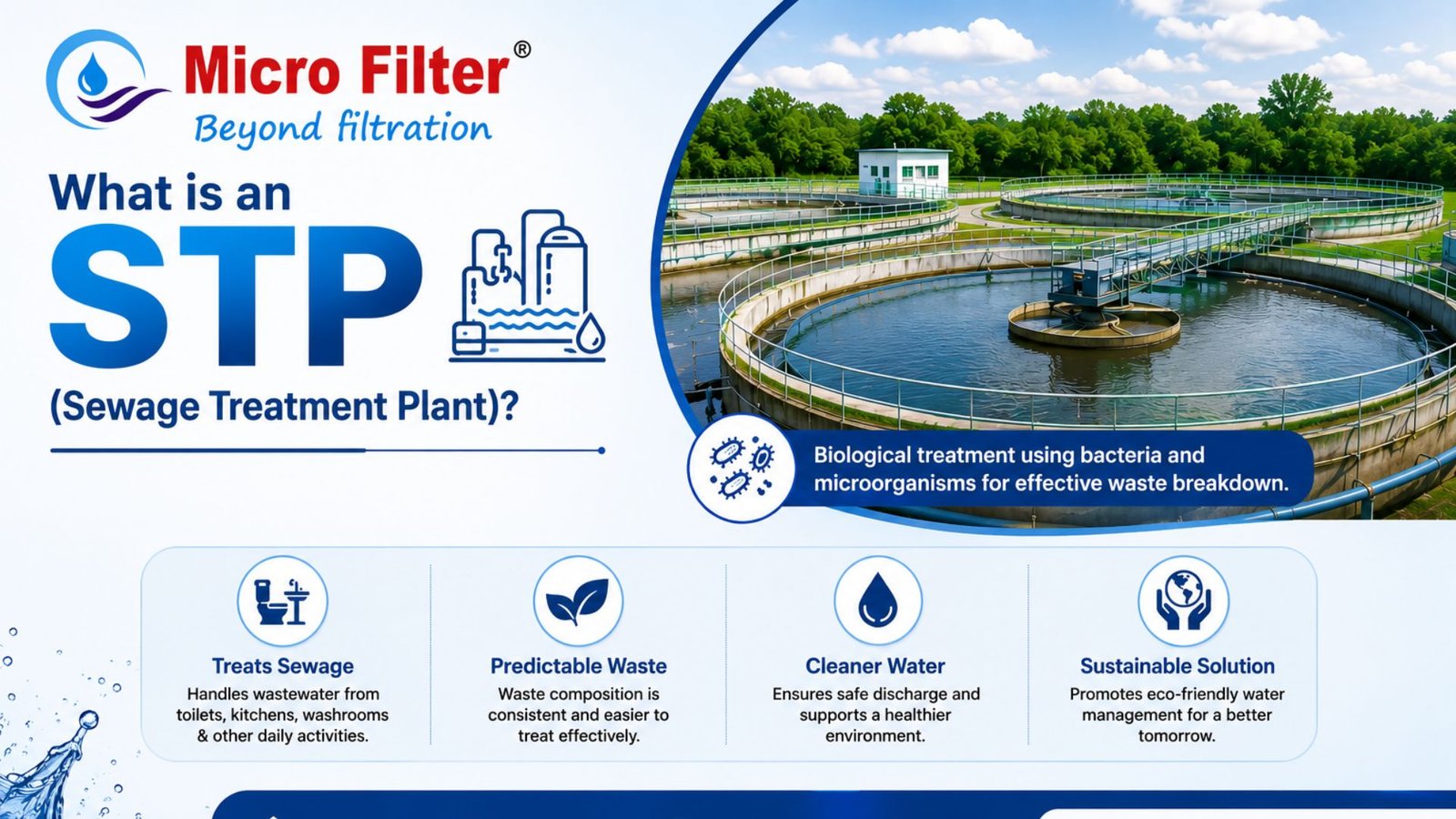
An STP is designed to treat sewage, basically the wastewater that comes from toilets, kitchens, washrooms and other everyday human activities. The waste going into an STP is fairly predictable. It’s mostly organic matter, pathogens and biodegradable material. Because of this, STPs rely heavily on biological treatment processes using bacteria and microorganisms to break down organic waste.
Common STP processes include:
- Screening and grit removal (removing large solids and sand)
- Primary settling (letting heavier solids settle down)
- Biological treatment activated sludge process (ASP), sequential batch reactor (SBR) or moving bed biofilm reactor (MBBR)
- Secondary clarification
- Disinfection (usually chlorination or UV)
The treated water from an STP is typically safe enough for gardening, flushing or other non drinkable use,it also depends on how far you take the treatment.
What is an ETP (Effluent Treatment Plant)?
An ETP, on the other hand, deals with processed wastewater: the stuff that comes out of manufacturing units such as chemical plants, textile mills, pharma companies, automobile industries etc.
Unlike sewage, industrial effluent isn’t predictable at all. It can contain heavy metals, oils, chemicals, dyes, acids or toxic compounds and the composition changes depending on what the industrial production process.
Because of this variability, ETPs usually need a mix of treatment methods, not just standardized ones.
Common ETP processes include:
- Physical treatment (screening, oil-water separation, sedimentation)
- Chemical treatment (coagulation, flocculation, neutralization of pH)
- Biological treatment (only where organic load is significant)
- Advanced treatment: membrane filtration, reverse osmosis or evaporation, depending on the industry
ETPs are built to handle toxic and non-biodegradable pollutants that a standard STP simply isn’t equipped to deal with.
STP vs ETP: The Core Differences
Parameter | STP | ETP |
Source of water | Domestic/municipal sewage | Industrial/Institutional |
Nature of waste | Mostly organic, biodegradable | Often chemical, toxic, variable |
Primary treatment method | Biological | Physical + chemical + biological |
Waste composition | Fairly consistent | Highly variable, process-specific |
Typical users | Residential complexes, hotels, hospitals, layouts | Factories, chemical/textile/pharma units/Hospitals |
Design complexity | Relatively standardized | Customized as per industry and waste type |
Reuse of treated water | Gardening, flushing, utilities | Depends heavily on effluent type and treatment level, but can be resumed after tertiary treatment |
Why This Distinction Actually Matters
A lot of facilities make the mistake of treating this as a minor technical detail but it isn’t.
If you run an STP designed for domestic sewage but try to push industrial effluent through it, the biological treatment stage can fail outright. Chemicals and heavy metals kill off the bacteria on which the entire system depends on. Your plant stops working, discharge quality drops and you risk violating pollution control norms.
On the flip side, installing a full-scale ETP for a residential society that only produces domestic sewage is unnecessary and expensive. You’d be paying for chemical dosing systems and advanced filtration you don’t actually need.
The right approach is always to match the treatment system to the actual waste stream generated & enduse, not the other way around.
Which One Do You Need?
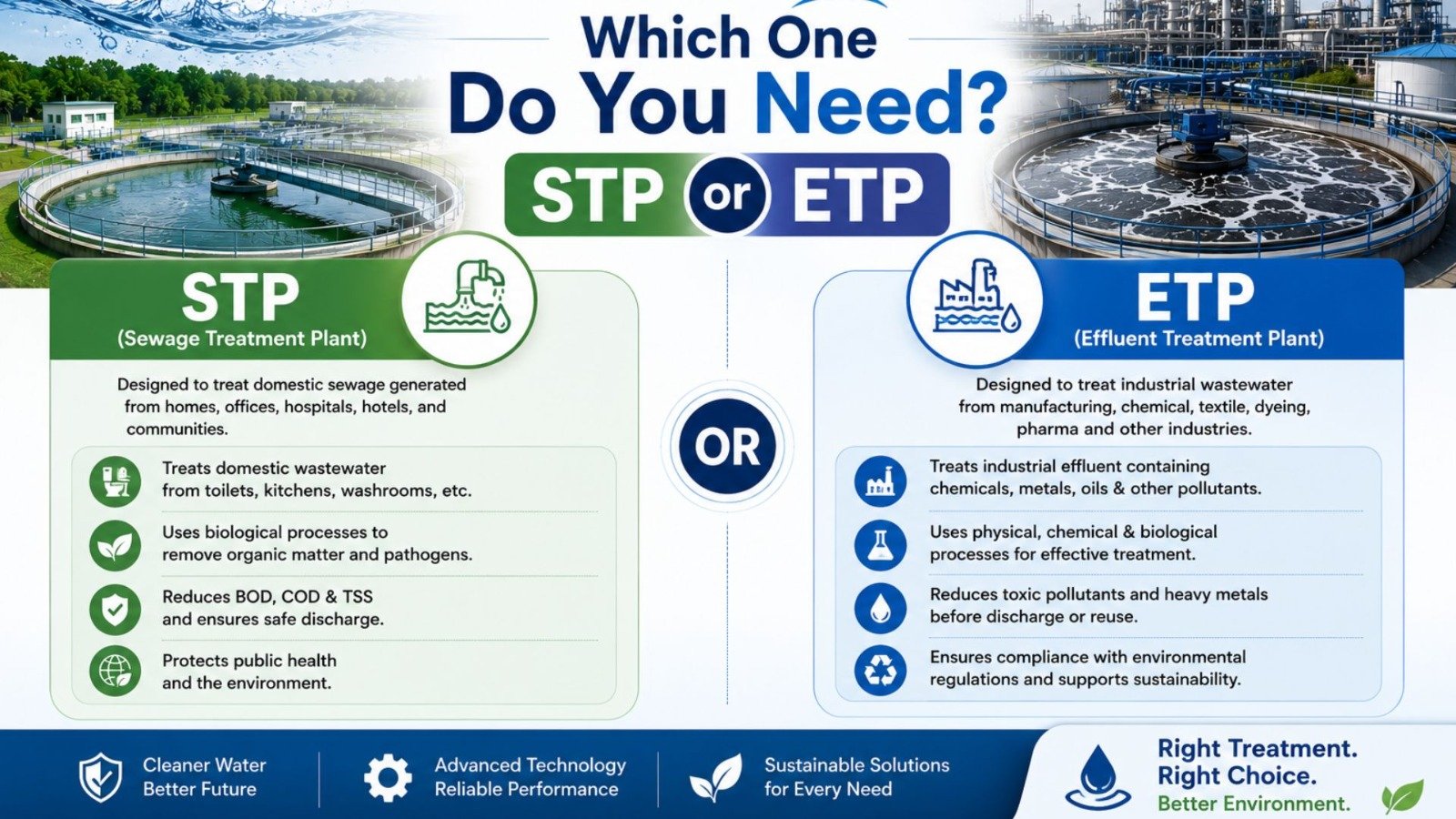
Ask yourself a simple question: where is your wastewater coming from?
- Only from toilets, kitchens, washrooms activity → You need an STP.
- From a manufacturing or production process (chemicals, dyes, oils, hospitals, industrial washing) → You need an ETP.
- Both: for a large industrial campus with staff quarters and a manufacturing units → You likely need both systems running separately.
Some larger facilities also route their STP-treated water into further stages, especially if it’s meant for recycling within the plant. But that’s a design decision that depends on your site layout and regulatory requirements, it’s not something to guess at but using treated waste water, called recycled water, is very important. It not only saves money but also reduces burden on previous potable drinking water.
Benefits of Getting This Right
- Regulatory compliance: Pollution Control Boards inspect discharge water quality against specific standards for STP & ETP. Using the correct system keeps you compliant.
- Lower operating costs: Correct & right-sized treatment means you’re not overspending on chemicals or energy for a waste load for which your system was never designed to handle.
- System longevity: Feeding correct system design of the waste into a correct a treatment plant increases equipment life and reduces maintenance frequency.
- Water reuse potential: Correctly treated water, whether from an STP or ETP, opens up options for reuse in gardening, cooling towers or industrial processes, cutting down on freshwater consumption.
How Microfilter Helps
This is exactly the kind of assessment our team does for you. We are Based in Nagpur, we’re an ISO 9001:2015 certified company and over the years we’ve worked with huge number of systems. Commercial customers across water sewage and effluent treatment. That experience is what lets us look at a facility and tell fairly quickly whether it needs an STP, an ETP or a combination of both instead of pushing a standard package that doesn’t fit.
We also don’t stop at installation. Our teams support plants with after-sales services, maintenance and troubleshooting, so the system keeps performing the way it was designed for years after commissioning.
If you’re unsure whether your facility needs STP, ETP or both, then reach out to us. It’s worth figuring it out before you invest in equipment, not after. You can reach us at in**@*********er.org or +91 98231 83355 for a proper site assessment & customised solutions.
Final Thoughts
STP and ETP aren’t interchangeable systems, they’re built for fundamentally different jobs. One handles the wastewater we all generate every day and the other handles what industries produce during the manufacturing process. Getting this distinction right, from the design stage itself, saves you compliance headaches, installation cost, operating costs and a lot of troubleshooting down the line.
If you’re setting up a new facility or unsure whether your current system is doing its job properly, it’s worth getting a professional assessment done before problems show up in your discharge reports.